

Sun Belt Rising
The emerging dominant paradigm in our politics—Sun Belt vs. Rust Belt—could be the fulcrum upon which 21st century American politics turns.


“Reagan’s policies are turning our industrial Midwest into a rust bowl.” So said then-presidential candidate Walter Mondale to assembled steelworkers at an industrial facility in Cleveland, Ohio, in 1984. The facility’s parent company went out of business in 2001.
While the phrase “rust belt” appeared with increasing regularity beginning in 1980, it was Mondale who brought the term to the fore with his critique of the Reagan Administration’s lifting of steel import quotas. Since then, the Rust Belt—states in the (formerly) industrial Midwest whose economies have been hollowed out with the decline of domestic manufacturing—has been a recurring theme in our politics and culture.
The Rust Belt is a bogeyman, and perhaps rightly so: it’s oft-cited as proof of American decline, the reason Barack Obama won in 2008 and Donald Trump won in 2016 and in 2024, an example of where free trade absolutism falls apart… the list goes on.
Where the Rust Belt exudes pessimism—long gone are the days when it was primarily referred to as “America’s Heartland”—the “Sun Belt” embodies optimism. The term was first coined by Kevin Phillips, an advisor to Richard Nixon, in The Emerging Republican Majority. Today, this region leads the nation in in-migration and economic growth.
This brief analysis dives into the diverging economic, population, and political trajectories of these two regions and makes some modest predictions about what’s in store in the decades to come.
Not enough attention has been paid to the Sun Belt. Our national consciousness remains mired in nostalgia and continues to under-index the incredibly bright trajectory of states like Arizona, Nevada, Texas, Georgia, and Florida.
Diverging trajectories
The Sun Belt’s population climbed upwards as the Rust Belt’s population leveled off following World War Two, with Sun Belt states overtaking Rust Belt states in the mid-2000s.
After indexing the base year (1950) to 100—allowing us to analyze both regions’ population growth on their own terms—the difference in population growth rates is more striking: the Sun Belt grew 5.2 times since 1950, and the Rust Belt grew only 1.5 times. Compare this to the population growth of the entire United States during this same period: 2.3 times its 1950 baseline.
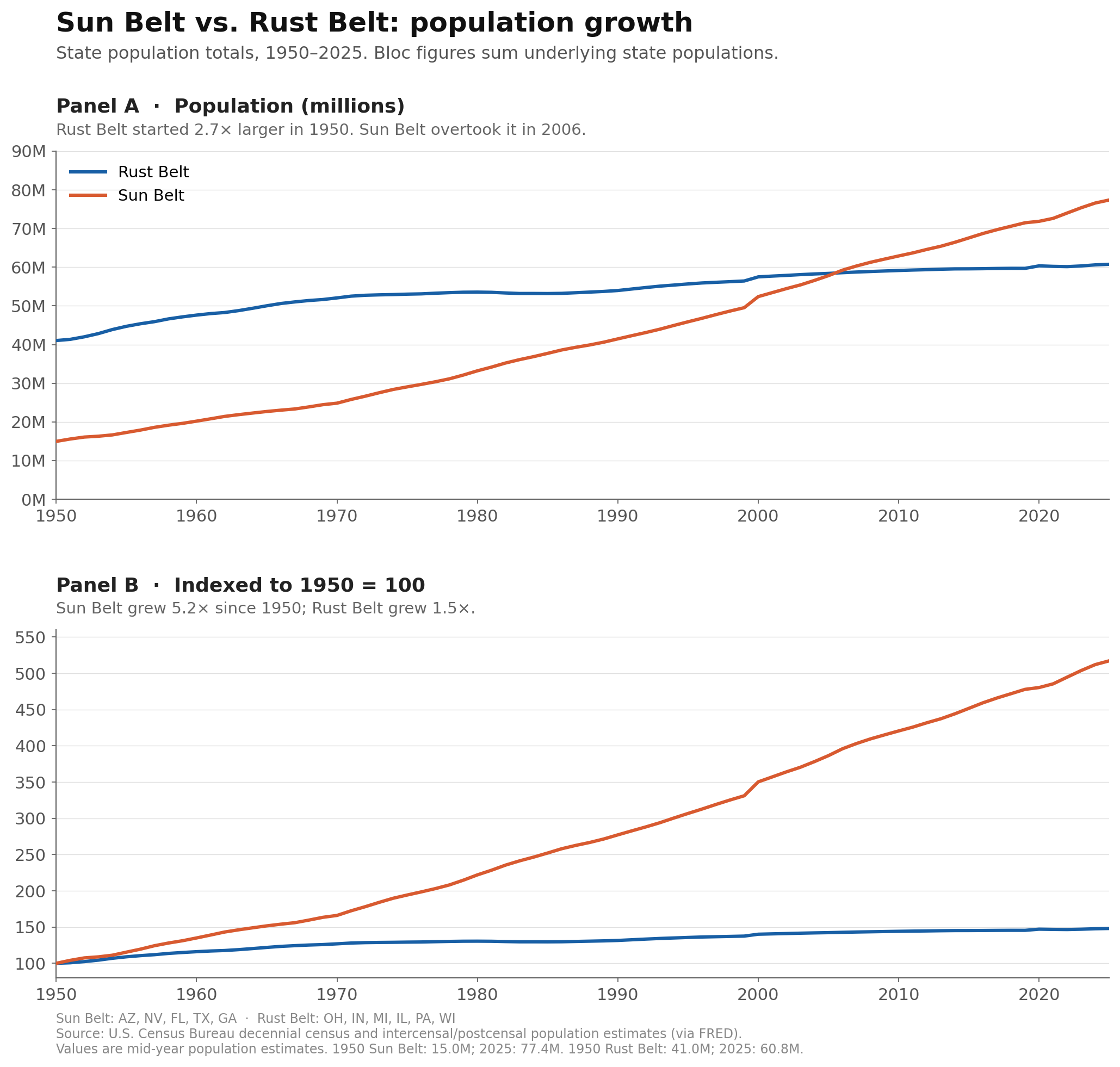
Despite the divergence in population growth rates, the Rust Belt still grew by ~20 million people since 1950 (larger than the total population of Sun Belt states in 1950). They just grew remarkably slower than the Sun Belt and the national average.
The Sun Belt’s growth is not a pro-natalist success story. It’s mostly a story of sustained net positive migration, driven primarily by Americans leaving other states and new arrivals from abroad.
The decline in natural population increase (births minus deaths) from 2011 through 2024 is not a result of declining births (these held steady, at ~840k per annum), but of more deaths (climbing from ~482k in 2011 to ~655k in 2024). I suspect this is a result of the Sun Belt’s large elderly population.
A surge in international immigration in the early-to-mid 2020s—which can be presumed to have leveled off significantly given the Trump Administration’s restrictionist immigration policy—contributed mightily to more recent surges in Sun Belt population growth.
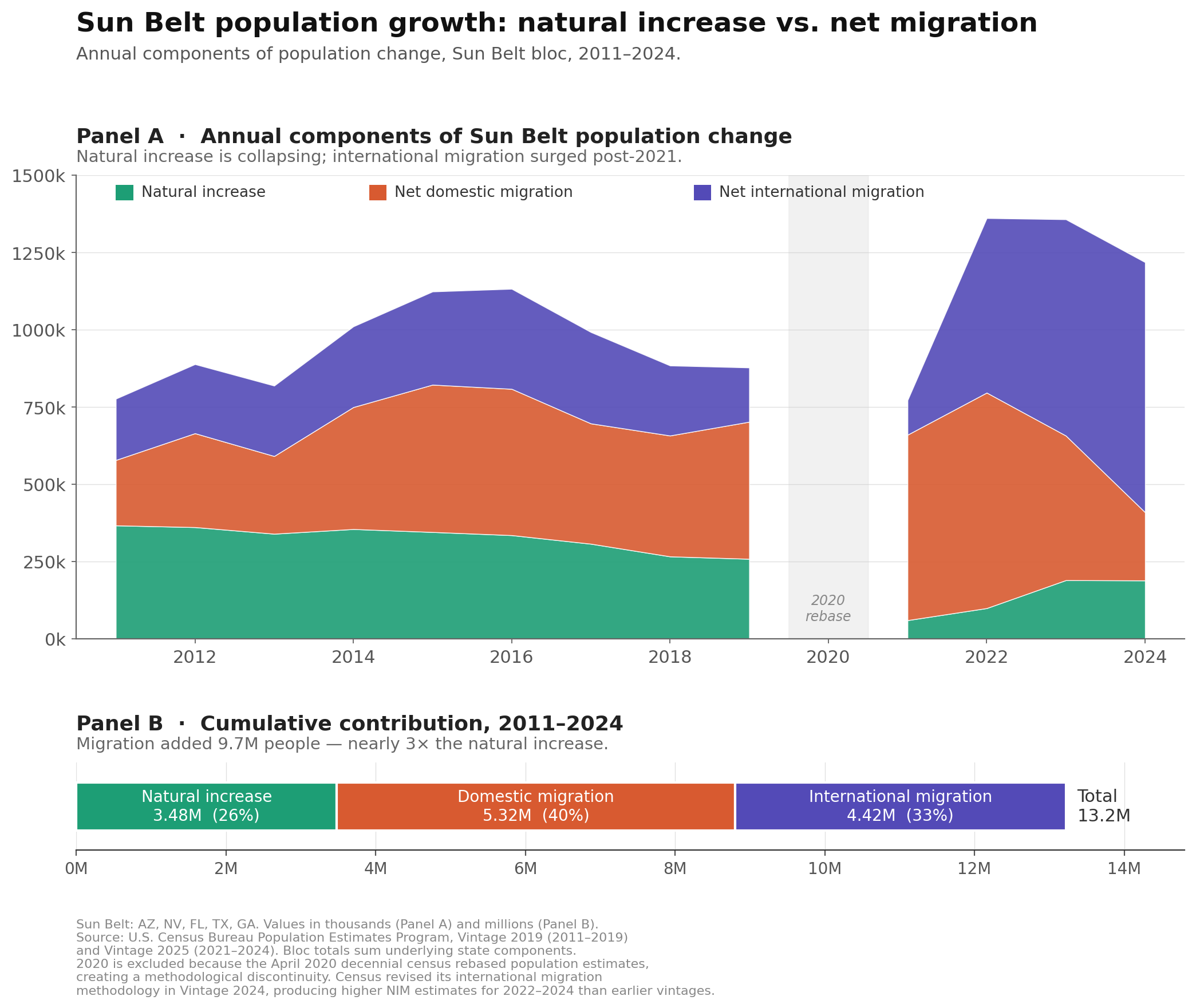
Worryingly, the region’s wild population growth has been migration-dependent: There is no shelter from the global fertility decline in the Sun Belt’s balmy climes. These states are simply doing a better job of luring people from other places.
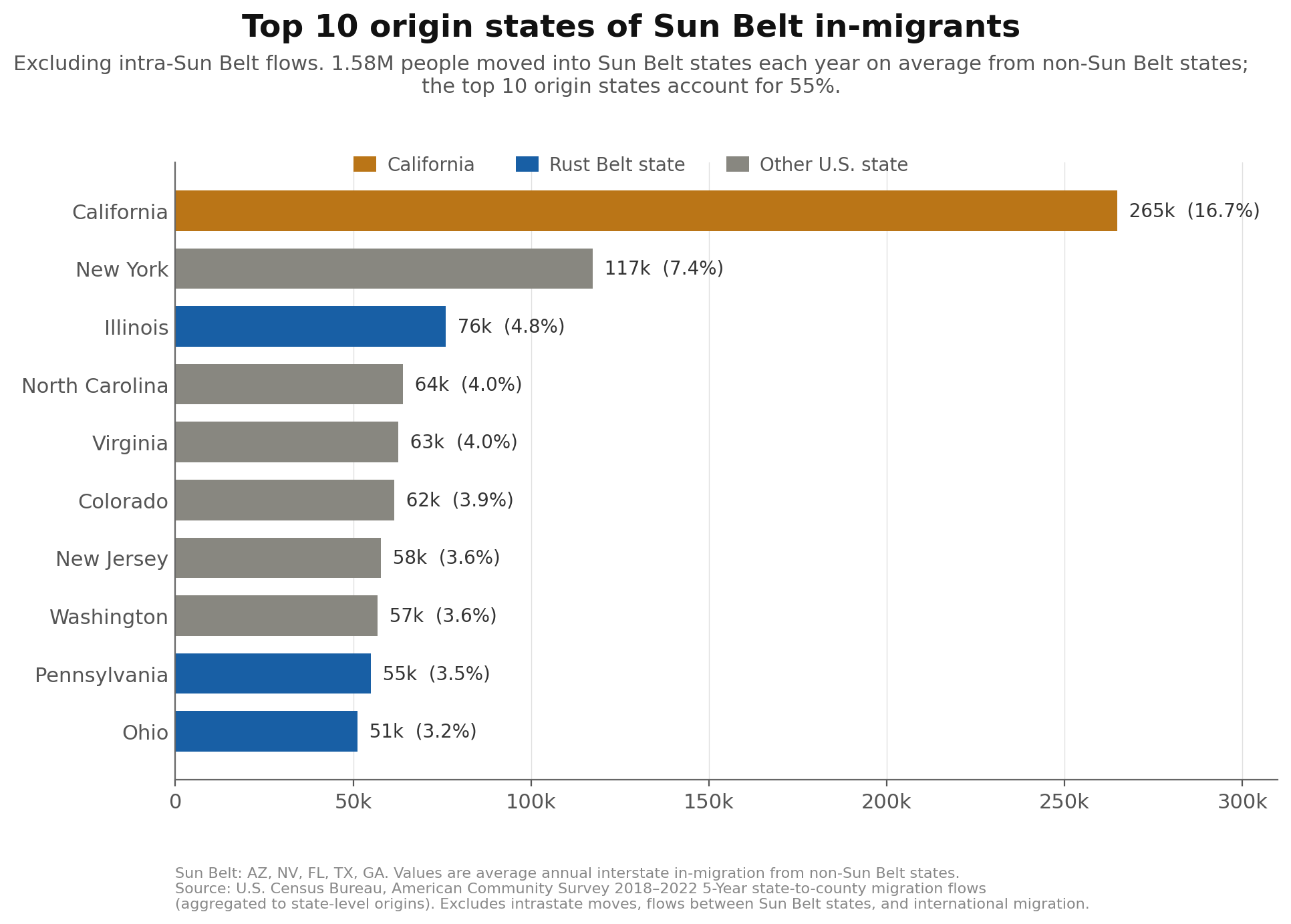
California (265k Sun Belt migrants annually, per the 2018–2022 ACS 5-Year estimates), New York (117k), Illinois (76k), North Carolina (64k), and Virginia (63k) are the leading sources of domestic Sun Belt migrants (for the purposes of this analysis, I excluded intra-Sun Belt migration).
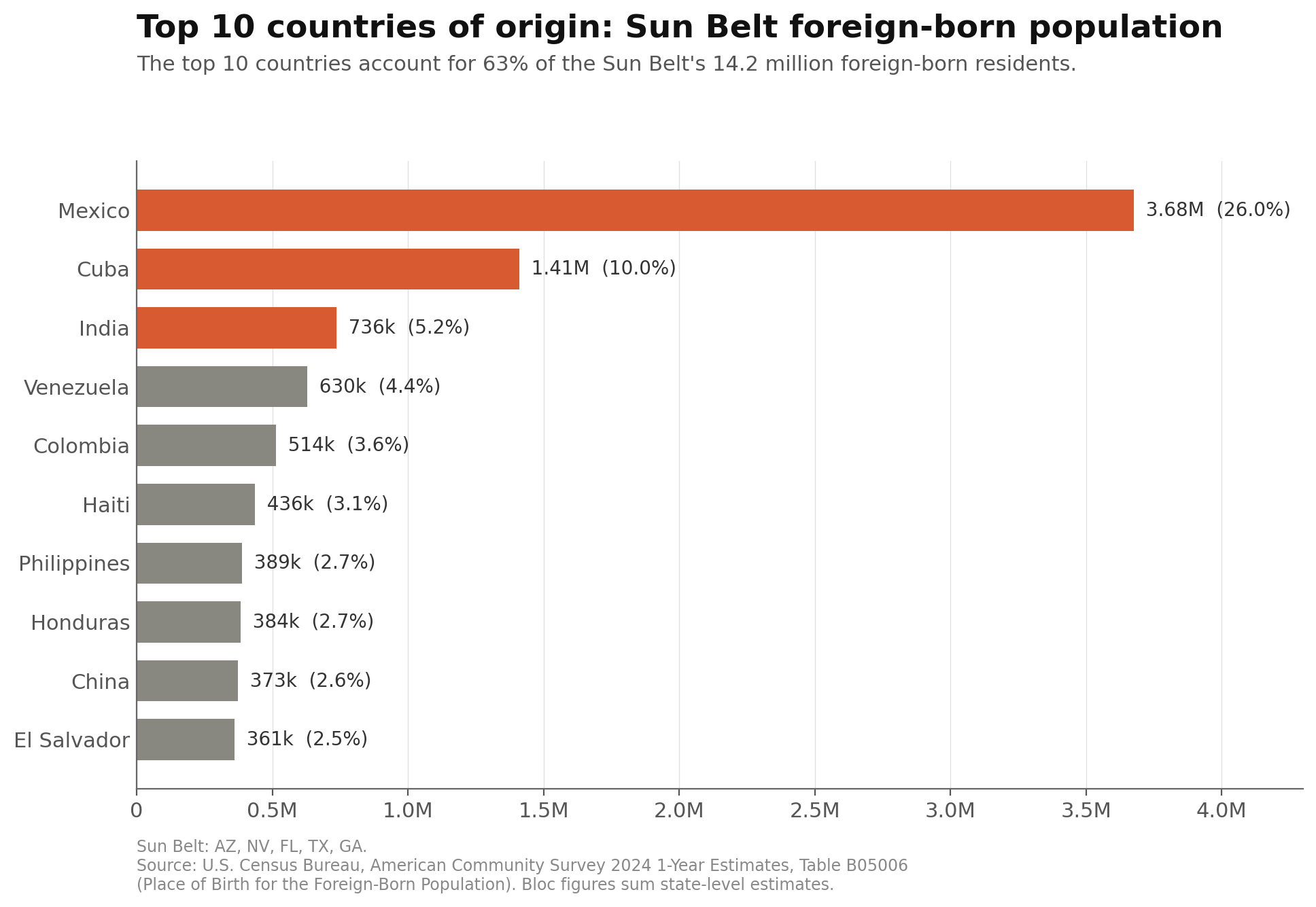
Foreign Sun Belt migrants are primarily from Latin America, with Mexico and Cuba leading the pack. The only non-Latin American nations in the top 10 countries of origin for the Sun Belt’s foreign born population are India (at #3) and China (#9).
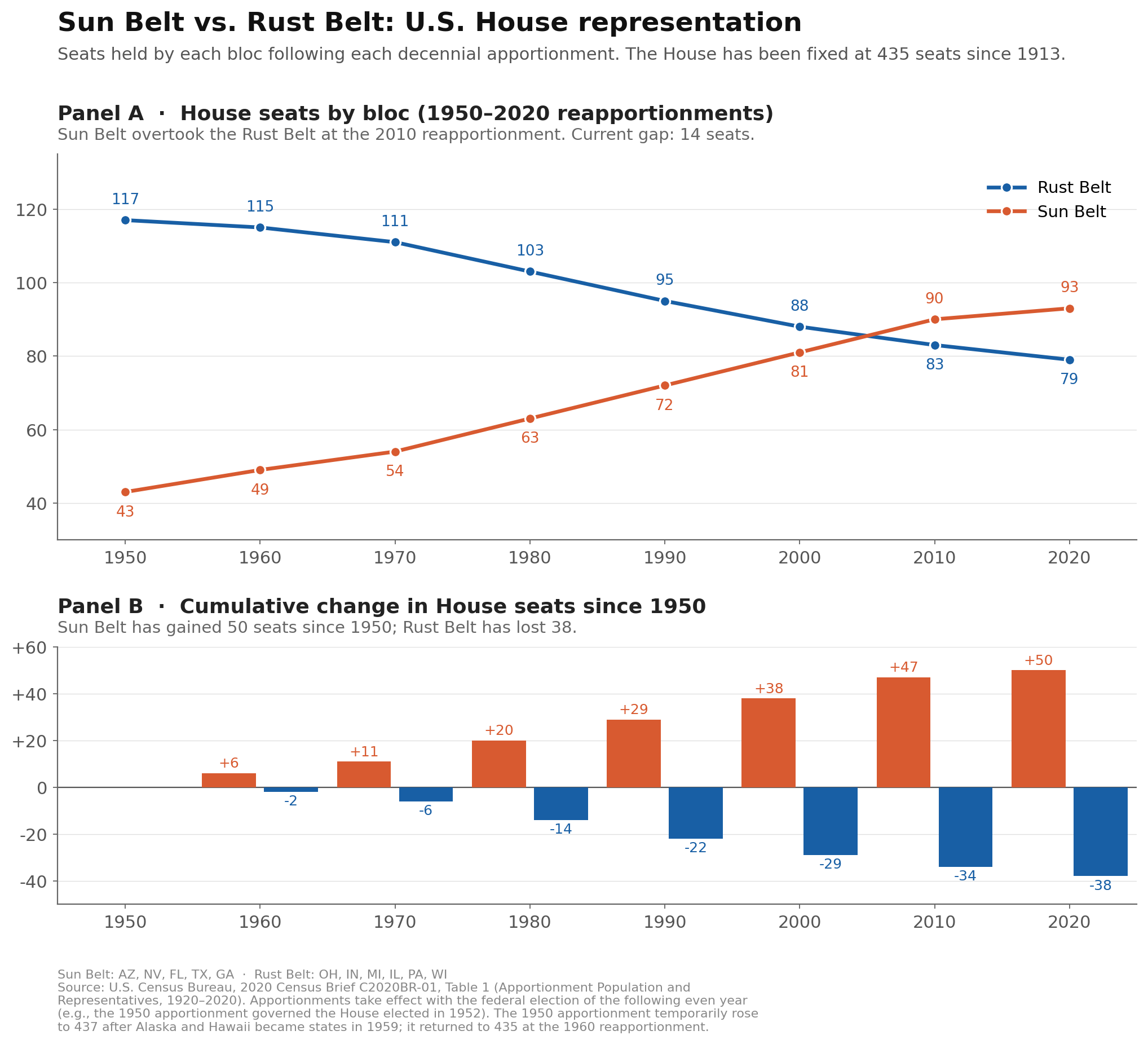
The Sun Belt’s population growth has steadily improved its political representation. From 1950 to 2020, Sun Belt Congressional representation increased by 50 seats—doubling its national political footprint in 70 years. The Rust Belt, on the other hand, lost 38 seats. 21% of the U.S. House of Representatives now hails from a Sun Belt state.
Texas and Florida have driven these gains, but smaller Sun Belt states—Arizona, Nevada, and Georgia—have had large percentage gains:
Texas: +16 (22 → 38) — 73% increase
Florida: +20 (8 → 28) — 250% increase
Arizona: +7 (2 → 9) — 350% increase
Georgia: +4 (10 → 14) — 40% increase
Nevada: +3 (1 → 4) — 300% increase
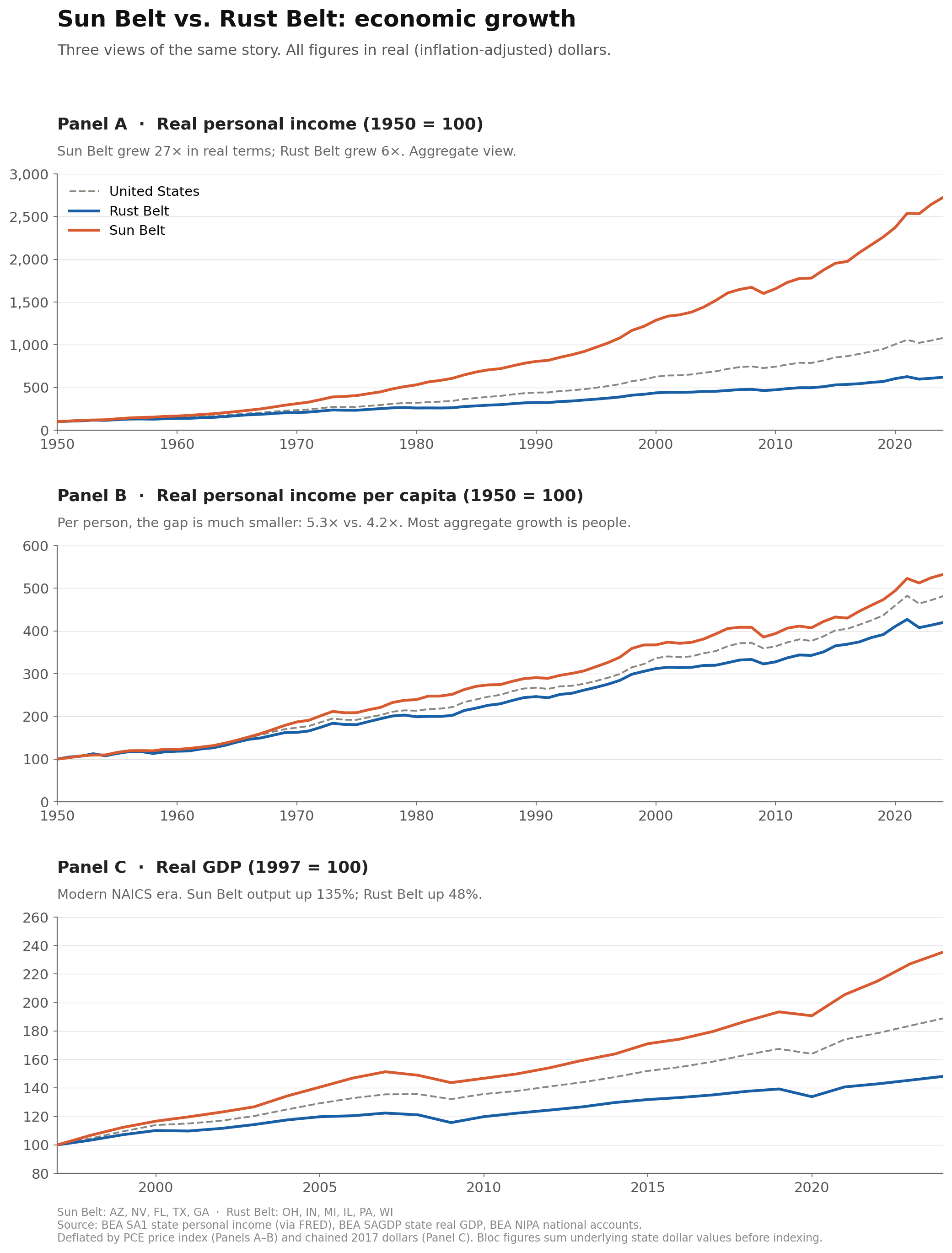
Sun Belt population growth has driven dramatic economic gains. The rate of increase for the region’s real personal income and real personal income per capita has exceeded the national average and the Rust Belt average. The Sun Belt’s real GDP growth since at least 1997 outperforms the Rust Belt.
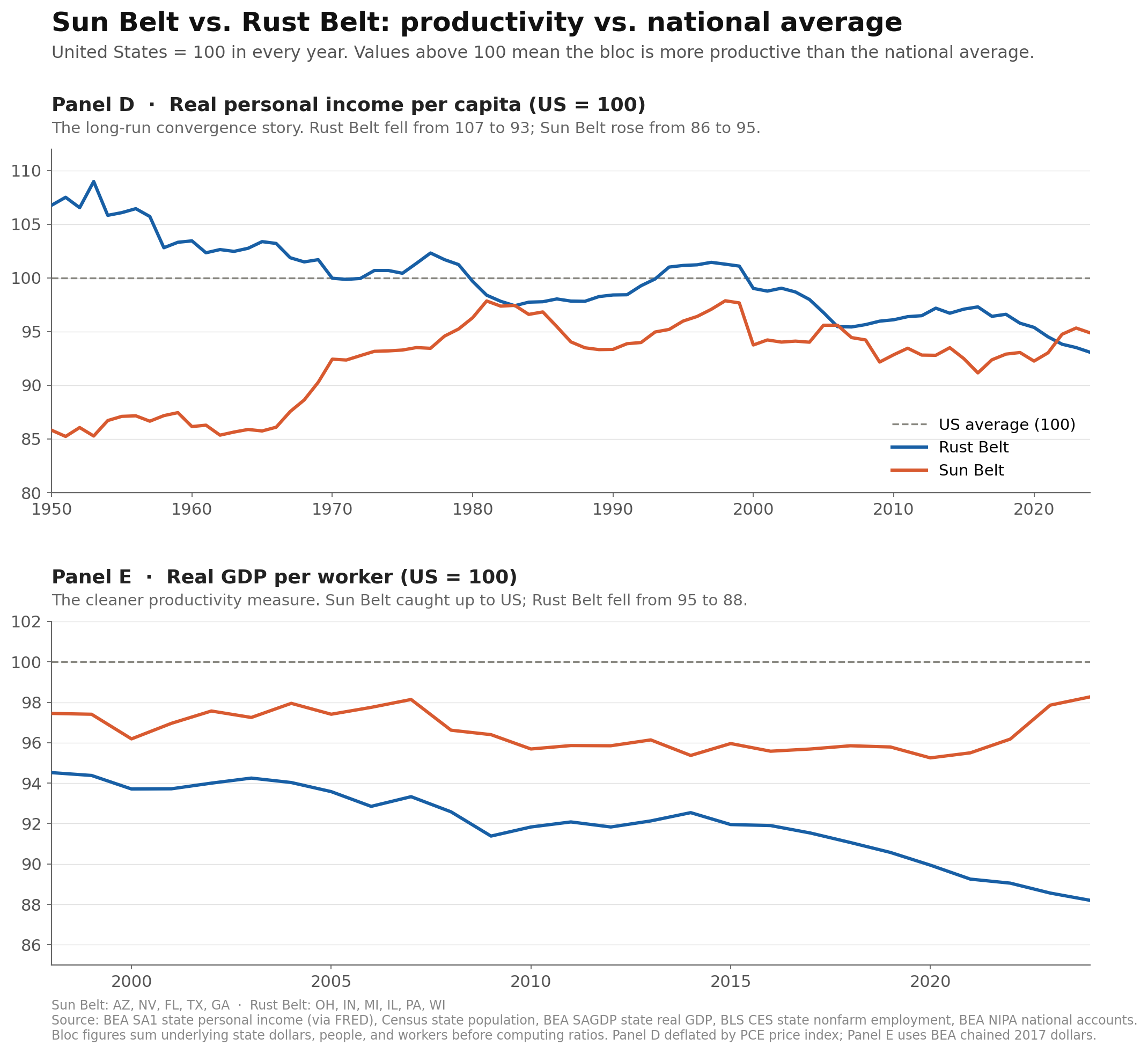
Interestingly, Sun Belt economic growth is driven more by population growth than by gains in per-worker output. The Sun Belt is slightly more productive than the Rust Belt and has reached rough parity with the national average, but it hasn't yet pulled ahead of U.S. national productivity.
The Sun Belt closed most of its per capita income gap with the Rust Belt by the early 1980s but the two blocs then moved roughly in lockstep for decades, both stuck a few points below the national average. Real GDP per worker has improved marginally in the last quarter century compared to the national average (especially vis a vis the Rust Belt) but it still underperforms the national average.
Takeaways
The Sun Belt’s trajectory remains bright, but there are two key trends that policymakers and entrepreneurs should keep an eye on:
Sun Belt population growth is driven primarily by immigration, not an increase in net births.
Domestic and international immigration are contributing to recent Sun Belt population growth more than net births. In order to keep pace, the region will need to find ways to maintain net in-migration flows to the region (keeping in mind, of course, that immigration—especially foreign immigration—has non-economic impacts that should be weighed carefully). The region can also find new ways to increase net births, remembering that the large senior population will continue to weigh down natural population growth.Sun Belt economic growth has primarily been a function of population growth, not productivity gains.
The Sun Belt generally outperforms the Rust Belt in terms of productivity, but still lags behind the national average. To sustain growth with or without sustaining high net in-migration numbers, Sun Belt leaders can focus their attention on increasing economic productivity. This might entail better supporting the development of high-productivity industries and the cultivation of a more highly skilled workforce.
Decline is a choice, but so is success. The region’s newfound vitality is not inevitable.
National implications
Our contemporary politics is coming to be shaped by two certifiably American worldviews.
Rust Belters have experienced American decline firsthand. They grew up in towns with hollowed out factories, declining populations, and a general air of pessimism. Every day, they are reminded of what was—they mourn a world lost. Their grievances are not without basis.
Sun Belters grew up in places built yesterday: new suburban developments, exurbs, and skyrises. Every day they are reminded of what can be—they anticipate a world to come. If they have grievances, they are with Rust Belters, who, to them, are mired in a past that can never be restored.
These worldviews cut across party lines. Ezra Klein and Doug Ducey are both Sun Belters, preferencing growth and believing that decline can be averted by embracing innovation and the wave of the future.
JD Vance and Bernie Sanders are both Rust Belters, seeing the world through the lens of scarcity and believing that decline can be averted by restoring the past, or at least elements thereof (higher rates of unionization, reshored manufacturing, etc.).
(A brief aside: Sanders does not hail from a Rust Belt state. The Sun Belt and Rust Belt attitudes are regionally sourced but nationally distributed.)
If the Sun Belt’s sunny trajectory continues apace—signs are good, but far from certain—Sun Belters will exercise an increasingly large role in our politics. Does this mean that Sun Belt policies will gain traction? Not necessarily. Sufficient backlash to streamlined regulation, improved state capacity, and elevated but perhaps inequitably distributed economic growth could put the Rust Belters back in the driver’s seat.
The emerging dominant paradigm in our politics—Sun Belt vs. Rust Belt—cuts across party lines. It could be the fulcrum upon which 21st century American politics turns.
Joe Pitts is the president of the 1912 Institute.